
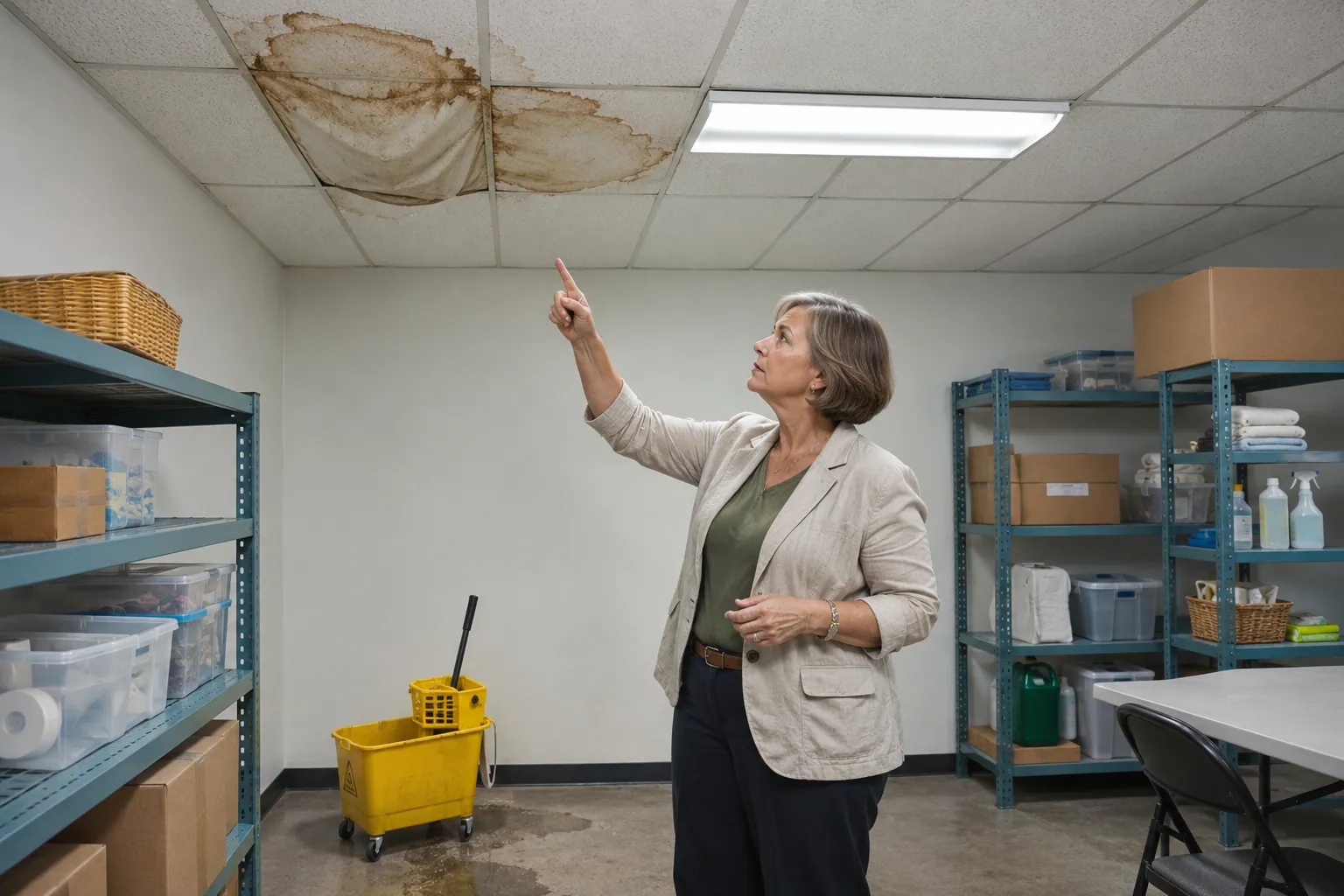
Hopkinsville Commercial Roof Repair Questions
Straight Answers on Seams, Screws, Ponding, and Pitch Pans
These are the Hopkinsville commercial roof repair questions building owners ask most, from open seams to permits in each nearby town.
About These Hopkinsville Commercial Roof Repair Questions
Every answer below covers Hopkinsville commercial roof repair questions on real roofs, grouped into 9 topics with 41 questions.
Commercial roof repair is the work of finding and fixing leaks, failed seams, damaged flashing and rusted metal on an existing roof so the building stays dry. Hopkinsville Commercial Roof Repair fixes flat, metal and industrial roofs on commercial and farm buildings across Hopkinsville and Christian County, Kentucky, plus surrounding towns.
Basic Commercial Roof Repair Questions From Hopkinsville Owners
What does a commercial roof repair crew fix?
A repair crew fixes the specific spots where water gets in, from split seams and punctured membrane to loose screws and rusted panel laps. The goal is to stop each leak at its source and leave the rest of the roof working.
Repairs cover a wide range of roof details.
- Seam failures on TPO, EPDM and modified bitumen roofs
- Flashing gaps at curbs, parapets, skylights and pipe penetrations
- Clogged or damaged drains, scuppers and gutters
- Backed-out fasteners and rusted end laps on metal roofs
- Pitch pans that have dried out and cracked
Each repair is matched to the roof material so the patch bonds to what is already there.
Which signs show a roof has moved past repair into restoration or replacement?
Repair handles damage confined to a few spots, restoration renews a dry roof worn across its whole surface, and replacement answers wet insulation or deck damage spread widely.
| Roof condition | Repair | Restore | Replace |
|---|---|---|---|
| A few open seams or punctures | Yes | – | – |
| Weathered surface, many small cracks, dry insulation | – | Yes | – |
| Wet insulation over large areas | – | – | Yes |
| Rusted steel deck at several drains | – | – | Yes |
| Loose screws and some rusted laps on metal | Yes | Yes, after repairs | – |
A moisture survey and a walk along every seam decide which column applies to a given roof.
Does one crew repair both flat roofs and metal roofs?
Yes, the same repair crew handles flat membrane roofs and metal roofs, with different tools and materials for each. Membrane repairs use matching sheet, primer and heat or tape, while metal repairs use panels, screws, butyl tape and sealant.
| Repair task | Membrane roof | Metal roof |
|---|---|---|
| Open seam | Re-weld or re-tape the lap | Reseal the side or end lap, add stitch screws |
| Hole | Patch with matching membrane | Patch with matching metal or swap the panel |
| Flashing leak | New membrane flashing at curb or wall | New trim, closures or pipe boot |
| Fastener issue | Re-secure plates under a patch | Replace screws and washers |
Mixed buildings, such as a metal warehouse with a flat office roof, get both kinds of repair.
Flat Roof Repair Questions
More on flat roof repair in Hopkinsville.
What causes most flat roof leaks on commercial buildings?
Most flat roof leaks start at seams, flashing and drains, where the membrane changes direction or joins another material. Open field areas leak far less often unless something punctures them.
| Leak source | What it looks like on the roof |
|---|---|
| Seam failure | Lap edge lifting, open welds, dried sealant |
| Flashing at curbs and walls | Membrane pulled away at the base, open corners |
| Drains | Loose clamping ring, membrane cracked at the bowl |
| Punctures | Small holes near rooftop units from tools or foot traffic |
| Ponding | Dirt rings and algae where water sits for days |
Interior stains often appear some distance from the actual opening, so tracing starts on the roof near the stain and works upslope.
How are seams repaired on TPO, EPDM and modified bitumen roofs?
Each membrane bonds in its own way, so the seam repair method follows the roof material. Every method starts with cleaning the lap down to fresh, bondable material.
| Membrane | Seam repair method |
|---|---|
| TPO | Clean, re-weld with hot air, or weld a cover strip over the lap |
| EPDM | Clean, prime, apply seam tape or a cover strip, seal the edge |
| Modified bitumen | Heat-weld or cold-adhere a patch over the open lap |
| PVC | Clean with membrane cleaner and hot-air weld a patch |
Weathered TPO can resist welding, so a cleaning and a test weld come before the full repair. Each repaired seam is probed afterward to confirm it is closed.
What should be done about blisters on a flat roof?
Blisters are pockets of trapped air or moisture between roof layers, and small, firm blisters are watched while broken or growing ones are cut open and repaired. A blister that splits lets water straight into the insulation.
Repairing an open blister follows four steps.
- Cut the blister in an X or remove the raised section.
- Dry the area and check the insulation under it for moisture.
- Replace any wet insulation.
- Patch with matching membrane or felts, extending past the cut.
Clusters of blisters across a roof often point to moisture in the system, which calls for a moisture survey before more patching.
How is ponding water fixed on a flat roof?
Ponding is fixed by getting water to the drains, whether by clearing blockages, adding slope or adding drainage points. Water standing on a flat roof long after rain ends wears seams and adds weight.
Each cause gets its own fix.
- Clogged drains and scuppers are cleared and get new strainers.
- Low spots from crushed insulation get tapered fill and a membrane patch.
- Water trapped behind a rooftop unit is split with a cricket.
- Deck sag between joists goes to structural review first.
After the fix, the next heavy rain shows whether the area drains fully, and any remaining ring of dirt marks where more slope is needed.
How are punctures in a flat roof membrane repaired?
A puncture is repaired with a patch of matching membrane that extends well past the hole on every side, after the area is cleaned and the insulation under it is checked for water. Wet insulation is cut out and replaced before patching.
Punctures cluster around rooftop units, where dropped screws, tools and service traffic hit the membrane. Follow-up steps keep new holes from forming.
- Walkway pads are added on the service side of each unit.
- Loose debris and screws are swept off the roof.
- HVAC contractors are asked to report any damage they cause.
Commercial Metal Roof Repair Questions
More on metal roof screw and lap repairs.
Why do commercial metal roofs leak around screws?
Screw leaks start when the rubber washer under the screw head hardens and cracks, or when the screw backs out as the panels expand and contract. Water then follows the screw shank into the building.
| Screw problem | Repair |
|---|---|
| Cracked or flattened washer | New screw and washer |
| Screw backed out | Remove and reseat, or upsize to a larger diameter |
| Stripped hole | Upsize the screw or add a stitch screw beside it |
| Over-driven screw | Replace so the washer seats flat and snug |
Fastener repair on an exposed-fastener roof covers every screw in the leak area, since washers of the same age fail together.
What repairs fix rusted panels and rusted end laps on a metal building?
Rusted panels are cut out and replaced, or patched with matching metal when the rust is limited to a small area, and rusted end laps are opened, cleaned and resealed. Surface rust is wire-brushed and primed.
| Rust level | Repair method |
|---|---|
| Light surface rust | Brush, prime and repaint |
| Pinholes at an end lap | Clean, apply butyl tape, add a metal patch with stitch screws |
| Rust-through across a panel | New panel matching the rib profile |
| Rusted purlin under the lap | Structural repair before new metal |
End laps rust first because water sits in the overlap after every rain.
How are flashing leaks at curbs, walls and pipes repaired on a metal roof?
Flashing leaks on a metal roof are repaired by removing the failed trim or boot, cleaning the panel underneath and installing new flashing shaped to the rib profile.
| Location | Failure | Repair |
|---|---|---|
| Pipe penetration | Cracked or shrunken rubber boot | New boot formed to the ribs, sealed and screwed |
| Rooftop unit curb | Open joints on the upslope side | Rebuilt curb flashing with a diverter above it |
| Headwall | Sealant gone behind the flashing | New headwall flashing with counterflashing |
| Sidewall | Short or loose flashing leg | Longer sidewall flashing, refastened |
Water piles up on the upslope side of any curb, so that edge gets a cricket or diverter when the flashing is rebuilt. Smearing sealant over a split boot leaves the real failure in place.
How are gutters and eave trim repaired on a metal building?
Gutter repairs fix open seams, sagging hangers and blocked outlets, and eave trim repairs close the gaps where wind pushes rain under the panels. Both work together at the low edge of the roof.
Gutter and eave work includes these tasks.
- Resealing gutter seams and end caps
- Adding hangers where the gutter has sagged
- Clearing and resizing downspout outlets
- Replacing missing foam closures under panel ribs
- Refastening eave trim with new screws
An overflowing gutter can push water back under the panel ends and into the wall, which looks like a roof leak from inside.
Can hail-damaged metal panels be repaired?
Hail-damaged panels are repaired or swapped based on whether the impact cracked the finish, split a lap or broke a skylight panel. Dents alone leave the steel watertight in most cases.
| Hail damage | Repair approach |
|---|---|
| Cosmetic dents | Document for insurance; panel stays |
| Cracked paint at dents | Prime and repaint the spots, or swap badly hit panels |
| Broken skylight panels | New panels in a matching profile |
| Loose or broken screws | New fasteners in the impact area |
| Dented ridge cap or gutter | Reseal or replace the trim |
Take dated photos before repairs begin and share them with the insurance carrier.
Commercial Roof Leak Repair Questions
More on commercial roof leak tracing.
How is the source of a commercial roof leak traced?
Leak tracing starts at the interior stain, maps it to the roof overhead, then works upslope and outward to every seam, curb and penetration nearby. Water often travels along deck flutes or insulation joints before it drips, so the drip point and the roof opening rarely line up.
Tools used in tracing include these.
- Interior and roof measurements to match the stain to the roof
- Visual check of seams, flashing and pitch pans
- Seam probe on welded membranes
- Moisture meter readings around the suspected area
- Controlled water test, one detail at a time
The leak is marked, photographed and repaired, then rechecked after the next rain.
Where do leaks come from on each type of commercial roof?
Each roof type has its own usual leak points, so tracing begins at those spots.
| Roof type | Most frequent leak points |
|---|---|
| TPO or PVC | Seam welds, curb corners, pipe boots |
| EPDM | Seam tape edges, T-joints, shrinking wall flashing |
| Modified bitumen or built-up | Blisters, cracked flashing, dried pitch pans |
| Standing seam metal | End laps, ridge closures, pipe flashings |
| R-panel metal | Screw washers, side laps, gutters |
Skylights and rooftop units belong on every list, since each one adds a curb and flashing to the roof.
How does a stopgap leak repair compare with a permanent one?
A temporary repair stops water for now with sealant, tape or roof cement, and a permanent repair restores the roof material with a matching patch, new flashing or new metal. Temporary repairs buy time during storms or cold weather.
| Factor | Temporary repair | Permanent repair |
|---|---|---|
| Materials | Roof cement, mastic, repair tape | Matching membrane, weld or tape, new metal |
| Surface prep | Minimal, often on a wet roof | Cleaned, dry, primed |
| When used | Active leaks, storms, freezing days | Dry weather with proper prep |
| Follow-up | Needs a return visit | Checked at routine roof walks |
Temporary patches are logged so each one gets replaced with a permanent repair.
Why does a roof leak only during wind-driven rain?
Leaks that appear only in wind-driven rain come from vertical and edge details where wind pushes water sideways or uphill. Straight-down rain runs past these spots harmlessly.
Places to check include these.
- Parapet coping joints and the counterflashing under them
- Through-wall scuppers where the sheet metal meets the wall
- End laps and ridge closures on metal roofs
- Rooftop unit cabinets with loose access panels
- Wall vents and louvers above the roof line
A water test that sprays sideways at each spot helps isolate the source.
Can a leak come from a rooftop unit instead of the roof?
Many "roof leaks" come from the rooftop unit itself, through a clogged condensate line, a loose cabinet panel or a leaking duct seam over the curb. Checking the unit is part of every leak trace near a curb.
| Source | Sign on the roof |
|---|---|
| Condensate line | Water around the unit on dry days |
| Cabinet panel | Rain entering through loose screws or gaskets |
| Duct seam inside the curb | Stain under the curb only during cooling season |
| Curb flashing | Open corners or membrane pulled from the curb |
| Pitch pan on a gas line | Cracked or shrunken filler |
Unit repairs go to the mechanical contractor, while curb flashing and pitch pans are roofing repairs.
Industrial Roof Repair Questions
More on industrial roof repair for plants.
What repairs come up most on industrial roofs?
Industrial roofs need frequent repairs at equipment curbs, pipe supports, exhaust fans and service paths, where heavy use wears the membrane faster than open roof areas. Large spans also bring expansion joint and drain repairs.
| Area | Frequent repair |
|---|---|
| Exhaust fans | Grease-softened membrane cut out and replaced |
| Pipe supports | Pads added, torn membrane patched |
| Equipment curbs | Corners reflashed, curb caps resealed |
| Service paths | Worn membrane patched, walkway pads added |
| Expansion joints | Covers rebuilt, flashing resealed |
Repair logs by area show where wear repeats, which helps plan larger work.
How are pitch pans and pipe supports repaired on a plant roof?
Pitch pans are refilled with fresh sealer or replaced with pre-formed boots, and pipe supports are reset on protective pads so they stop cutting into the membrane. Both are common leak points on plant roofs crowded with piping.
- Remove cracked or shrunken filler.
- Clean the pan and the pipe or support leg.
- Refill with pourable sealer, mounded to shed water.
- Replace rusted pans with new metal or a pre-formed boot.
Pipe supports get rubber or membrane pads, and pipe racks that rock are re-leveled so they sit still in wind.
How is grease or chemical damage around exhaust fans repaired?
Grease-damaged membrane around exhaust fans is cut out and replaced with a grease-resistant membrane, and a grease containment unit is installed so new discharge lands in a catch pan. Patches over softened membrane fail because nothing bonds to it.
Repair follows four steps.
- Degrease the area and find the edge of the softened membrane.
- Remove damaged membrane and wet insulation.
- Install new insulation and a compatible resistant membrane.
- Mount a containment unit at the fan discharge.
Chemical exhaust gets the same approach, using a membrane matched to the chemical on the manufacturer's resistance chart.
Can industrial roof repairs be done while the plant is running?
Most industrial roof repairs happen while the plant runs, since repair areas are small and work stays on the roof surface. Scheduling and safety rules are agreed with plant staff before the crew goes up.
Planning covers these points.
- Equipment shutdowns for repairs at exhaust fans and curbs
- Hot work permits for torch-applied modified bitumen
- Fire watch when open flame is used near combustible dust
- Roof access through hatches, ladders or lifts
- Dust and debris control over sensitive production areas
Hot-air welded repairs on TPO and PVC avoid open flame, which simplifies work over many plants.
How are expansion joints and roof drains repaired on large industrial roofs?
Expansion joints are repaired by replacing split covers and resealing the flashing on each side, and roof drains are repaired by resetting the clamping ring, replacing broken strainers and patching cracked membrane at the bowl. Both handle large amounts of movement or water.
| Repair point | Failure | Fix |
|---|---|---|
| Expansion joint cover | Split bellows or torn cover | New flexible cover |
| Joint flashing | Membrane pulled from the curb | Reflash and terminate |
| Drain clamping ring | Missing bolts, loose ring | New bolts, reset ring |
| Drain strainer | Broken or missing | New cast strainer |
| Drain bowl area | Cracked membrane | Patch or new target sheet |
Weather, Permits and Codes in Hopkinsville
What should be checked on a commercial roof after a severe storm in Christian County?
After a severe thunderstorm warning from the NWS Paducah office passes, have the roof walked once it is safe, looking for wind and hail damage at edges and openings. Early checks catch damage before the next rain.
Storm checks cover six items.
- Edge metal and coping lifted or bent
- Membrane torn or ballast moved at corners
- Skylight panels cracked by hail
- Ridge caps and trim loosened on metal roofs
- Drains and scuppers clogged with debris
- Rooftop unit panels or ductwork displaced
Dated photos of every item support an insurance claim.
Which office answers roof repair permit questions in each nearby town?
The answer turns on the repair scope and the town, so the first call goes to the inspector the Kentucky DHBC contact sheet lists for that place. Deck replacement, structural fixes and large re-roof sections draw the most permit questions.
| Town | County | Inspector listed by DHBC |
|---|---|---|
| Hopkinsville | Christian | One local inspector covers the city and the county |
| Oak Grove | Christian | Separate Oak Grove local inspector |
| Cadiz | Trigg | Local inspector serving Cadiz and the county |
| Princeton | Caldwell | State inspector; no local office named |
| Elkton | Todd | State inspector; Elkton unlisted |
| Dawson Springs | Hopkins | Madisonville and Hopkins County local inspector, or state inspector |
| Greenville | Muhlenberg | County local inspector, plus a state inspector |
Describe the repair plainly on the call, including any deck, joist or purlin work.
Does a roof repair have to meet the current Kentucky Building Code?
Repairs follow the Kentucky Building Code in effect, which DHBC lists as the 2018 edition based on the 2015 International Building Code. Matching materials and methods keep a repair in line with the existing roof system.
Code questions come up during repair work in four places.
- Recovering a section over existing layers
- Replacing deck panels or structural members
- Adding or relocating rooftop equipment
- Changing drains, scuppers or roof slope
Wet material found under a patch area comes out before new layers go in, and the inspector settles any question about recovering.
How does winter weather in western Kentucky cause roof leaks?
Freeze-thaw cycles in western Kentucky winters open small gaps in seams, flashing and sealant, and water that freezes in those gaps widens them each cycle. Ice at drains and gutters also backs water up under laps.
Winter leak points include these.
- Drains blocked by ice, sending water to low seams
- Gutters packed with ice, pushing water under metal panel ends
- Sealant turned brittle at pitch pans and terminations
- Snow drifts against parapets and rooftop units, melting into wall flashing
Repairs in cold weather use temporary methods until dry, warmer days allow permanent work.
Cost Questions on Commercial Roof Repair in Hopkinsville
What makes one commercial roof repair cost more than another?
The size and location of the damage, the roof material and access to the repair area set the cost of commercial roof repair. A single open seam near the roof hatch takes far less work than a wet area under a rooftop unit.
Cost drivers include these.
- Hours spent tracing a hidden leak
- Wet insulation that must come out with the membrane
- Matching materials for older roof systems
- Lift or crane access to high roofs
- Number of repair areas in one visit
- Temporary repairs followed by permanent ones
Costs are discussed after an on-roof inspection sets the scope.
At what point do repeat repairs stop paying off on a commercial roof?
Repeated repairs start costing more than a larger fix when leaks keep appearing in new places, wet insulation keeps spreading, or the same seams reopen after repair. A repair log makes that pattern easy to see.
| Pattern in the repair log | What it points to |
|---|---|
| Same seam repaired twice | Membrane aging at laps |
| New leaks each storm season | Roof-wide wear |
| Wet areas growing between surveys | Insulation saturation |
| Screws loosening across many bays | Fastener failure across the metal roof |
At that point, a restoration or replacement review weighs the remaining roof condition against continued patching.
How are commercial roof repairs treated for taxes?
Tax treatment of a roof repair is a question for a CPA, since the line between a repair expense and a roof improvement turns on the scope of the work. IRS Publication 946 names roofs on existing nonresidential buildings as Section 179 property, with a 2026 limit of $2,560,000 that phases down after $4,090,000 in qualifying purchases.
Give the CPA these records.
- Invoices separating seam, flashing and panel repairs from larger roof sections
- Photos of the damaged areas before and after
- Dates the work was finished
Consult a CPA before treating any repair as a Section 179 deduction.
Questions by Town
How did the April 2025 flood crest near Hopkinsville affect roof leak tracing?
The South Fork Little River at Hopkinsville crested at 21.20 feet at the Bypass gauge on April 4, 2025, within 0.15 foot of its July 2016 record, according to the National Weather Service in Paducah. Buildings that took on floodwater during that storm can show stains unrelated to the roof.
Separating roof leaks from ground water follows a few clues.
- Ceiling stains point to the roof; wall-base stains point to flooding.
- Water rising from interior drain lines points to a backed-up storm line, a job for a plumber.
- Wet insulation found in core cuts confirms a roof source.
Tracing starts with the roof drains and the seams around them.
Do roof repairs in Hopkinsville need a city or county permit?
Hopkinsville and unincorporated Christian County are covered by the same local building inspector on the DHBC contact sheet, so the same office answers repair permit questions inside and outside the city. Call before any repair that goes past patching.
Repairs to raise with that office include these.
- Deck panel replacement at rusted drains
- Purlin or joist repairs under a metal roof
- Re-roofing a large section after a storm
- New curbs for replacement rooftop units
Keep the inspector's answer in the building's roof file with photos of the repair area.
Who handles repair permits in Oak Grove, separate from Hopkinsville?
Oak Grove has a local building inspector of its own on the DHBC sheet for Christian County, so repair questions for an Oak Grove building go to that office instead of the Hopkinsville inspector. The split matters for owners with buildings in both cities.
Share these details when calling about an Oak Grove repair.
- Number and size of damaged sections
- Any deck or framing work
- Storm damage being repaired under an insurance claim
- Equipment curbs being added or moved
A permit answer from one office carries no weight in the other, even for identical repairs.
What did 14 inches of rain in April 2025 reveal about drains on Cadiz roofs?
The Cadiz 4 SW station logged 14.30 inches during the first week of April 2025, a total published by NWS Paducah and among the highest in the region. Flat roofs in Cadiz that held water after that storm showed where drains and scuppers fell short.
Repairs that follow a rain event like that include these.
- Clearing drain lines and replacing broken strainers
- Adding overflow scuppers through parapet walls
- Cutting out blisters that formed over wet insulation
- Patching membrane softened at long-standing ponds
Owners can mark ponding outlines with paint after a rain so the repair crew sees the full footprint.
How much rain hit Princeton in April 2025, and how do metal roof laps handle it?
Princeton's 2 SE station logged 13.23 inches across the first week of April 2025, based on the NWS Paducah event summary. Days of steady rain like that push water into every end lap, side lap and screw hole on a metal roof.
Metal roof repairs after long rain include these.
- Resealing end laps with butyl tape and stitch screws
- Replacing screws with cracked washers
- Clearing gutters packed with leaves and grit
- Reflashing pipe boots that split in the sun
Interior stains that appear only after multi-day rain often trace to end laps, where water backs up slowly.
Who inspects structural roof repairs in Elkton?
Structural roof repairs in Elkton go through the state inspector the DHBC sheet assigns to Todd County, since no local inspector appears there for Elkton. Owners can check with Elkton city hall or the Todd County judge-executive's office first.
Structural repairs that raise permit questions include these.
- Replacing rusted steel deck panels
- Sistering or replacing purlins under metal panels
- Reinforcing framing for a heavier rooftop unit
Routine work like resealing laps, replacing screws or patching membrane is a smaller scope to describe on the same call.
What repair issues show up on Dawson Springs roofs rebuilt after the 2021 tornado?
Roofs repaired after the December 2021 tornado in Dawson Springs often join new material to older roof sections, and leaks tend to appear at those tie-ins. The National Weather Service documented the tornado's path through the town.
Problems to check include these.
- Laps between new and old metal panels with mismatched profiles
- Membrane patches welded to aged TPO that held poorly
- Flashing at rebuilt walls meeting older roof areas
- Fasteners in storm-twisted purlins
Dawson Springs is in Hopkins County, so permit questions start at city hall, then go to the inspector serving Madisonville and the county, or to the state inspector.
Why did Greenville roofs see heavy drainage stress in April 2025?
Greenville stations logged some of the largest totals in the region during the April 2025 storms, including 15.31 inches at Greenville 6.2 WSW and 13.18 inches at Greenville 0.3 ESE, per the National Weather Service in Paducah. Roofs that carried that much water need a close look at their drainage.
- Drain bowls checked for loose clamping rings
- Scuppers and conductor heads cleared and resealed
- Seams near drains probed for openings
- Gutters on metal buildings checked for sagging hangers
Permit questions for larger repairs go to the Muhlenberg County inspector.
What other towns near Hopkinsville get commercial roof repair service?
Nine smaller towns in Christian, Todd, Hopkins and Trigg counties are covered for commercial roof repair. Each town's first permit contact comes from its county's Kentucky DHBC sheet.
| Town | County | First permit contact on the DHBC sheet |
|---|---|---|
| Guthrie | Todd | City of Guthrie local inspector |
| Pembroke | Christian | Christian County local inspector |
| Crofton | Christian | Christian County local inspector |
| Herndon | Christian | Christian County local inspector |
| Lafayette | Christian | Christian County local inspector |
| Earlington | Hopkins | Madisonville and Hopkins County local inspector |
| Nortonville | Hopkins | Madisonville and Hopkins County local inspector |
| Cerulean | Trigg | Cadiz and Trigg County local inspector |
| Trenton | Todd | State building inspector |
Towns left off a sheet by name call city hall first to confirm.
Getting Started
What are the first steps after a commercial roof leak appears?
Protect the interior first, then document the leak and call for a repair visit. Quick steps limit damage to insulation, ceilings and inventory.
- Shift stock and equipment out from under the drip and put buckets down.
- Photograph the stain, the drip point and the date.
- Note the weather, such as wind direction or hours of rain.
- Check that roof drains and gutters are clear, if the roof is safe to reach.
- Avoid walking on a wet, slippery roof or poking at the membrane.
The notes help the repair crew trace the leak faster.
How does a commercial roof repair visit work from start to finish?
A repair visit starts with tracing the leak on the roof and ends with a fixed, rechecked repair area. The crew explains what they found and what was done before leaving.
The visit covers five tasks.
- Walking the roof around the leak area and nearby curbs
- Probing seams and checking flashing and pitch pans
- Making a temporary repair if weather blocks a permanent one
- Completing the permanent repair with matching materials
- Photographing the repair for the building's records
Call the office or request a free inspection to schedule a repair visit.
Sources
- Kentucky DHBC: Find Currently Enforced Code
- Kentucky DHBC contact sheet: Christian County
- Kentucky DHBC contact sheet: Trigg County
- Kentucky DHBC contact sheet: Caldwell County
- Kentucky DHBC contact sheet: Todd County
- Kentucky DHBC contact sheet: Hopkins County
- Kentucky DHBC contact sheet: Muhlenberg County
- National Weather Service Paducah: April 2025 Flooding
- National Weather Service: December 10-11, 2021 tornado outbreak
- IRS Publication 946: How To Depreciate Property
Question About Your Own Roof
Every roof is a little different. Call with what you see, and the answer comes from a look at the actual roof.
- Call with the symptom
- Roof walked and traced
- Findings photographed
Still Have Hopkinsville Commercial Roof Repair Questions
Ask about your own building. A roof walk answers what a page of answers cannot.