Cracked Pitch Pans
Pourable filler shrinks away from pipes and support legs. Plant roofs crowded with piping have dozens of these, and each one is a leak point.

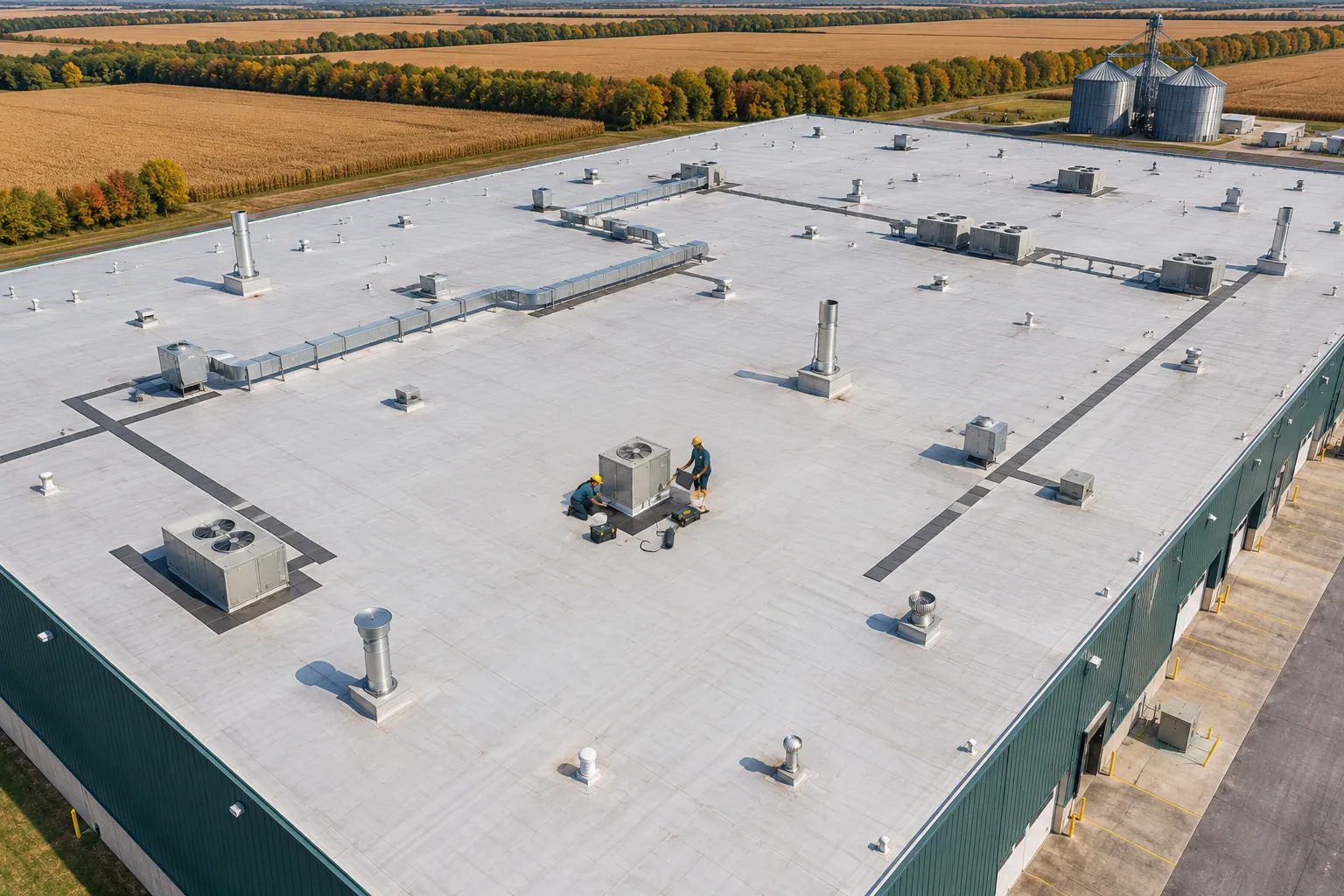
Work with a Hopkinsville industrial roof repair contractor that repairs plant roofs around curbs, fans, pipe racks, and expansion joints while production keeps running.
A Hopkinsville industrial roof repair contractor sorts plant roof damage by area and spread. Read across from the problem you see.
| What The Roof Shows | Area Repair | Repair With Shutdown | Larger Section |
|---|---|---|---|
| Cracked filler in a few pitch pans | Usually Fits | Rarely | Rarely |
| Pipe supports cutting into the membrane | Usually Fits | Rarely | Rarely |
| Grease-softened membrane around an exhaust fan | Sometimes | Usually Fits | Rarely |
| Split expansion joint cover | Usually Fits | Sometimes | Rarely |
| Worn service paths with wet insulation across a bay | Sometimes | Rarely | Usually Fits |
Repair logs by area show where wear keeps coming back, which helps plan the larger work in the last column.
Heavy use wears plant roofs fastest at equipment and the paths workers walk to reach it.
Pourable filler shrinks away from pipes and support legs. Plant roofs crowded with piping have dozens of these, and each one is a leak point.
Legs and racks that rock in the wind grind through the membrane under them. Pads and re-leveled racks stop the wear.
Grease and some chemical exhaust soften membrane until nothing will bond to it. Patches over softened membrane fail.
Long roof spans move with temperature, and the bellows or covers over the joint split. Flashing on each side pulls loose too.
Missing bolts and broken strainers at roof drains let water around the bowl. Cracked membrane at the bowl follows.
Foot traffic to the same units every week wears through the membrane along one route. Walkway pads go down once the wear is patched.
Each area of a plant roof has its own repair, matched to the membrane and what sits on it.
| Area | Failure | Repair |
|---|---|---|
| Exhaust fans | Grease-softened membrane | Cut out, replace with grease-resistant membrane, add a containment unit |
| Pipe supports | Torn membrane under legs | Patch, then rubber or membrane pads under each support |
| Pitch pans | Cracked or shrunken filler | Refill with pourable sealer, or a pre-formed boot |
| Expansion joints | Split bellows or torn cover | New flexible cover, reflashed and terminated |
| Roof drains | Loose ring, broken strainer | New bolts, reset ring, new cast strainer, patched bowl |
Plant roof repairs done by area keep production, maintenance, and the people on the floor working.
Softened membrane around a fan will not hold a patch. The damaged area gets cut out and replaced, with a catch pan at the discharge.
Industrial repairs are planned with plant staff first, then done area by area on the roof surface.
Curbs, fans, pipe supports, expansion joints, drains, and service paths are walked and logged by area, with moisture readings at worn spots.
Equipment shutdowns, hot work permits for torch-applied modified bitumen, fire watch near combustible dust, and roof access routes get agreed.
Softened, torn, or wet membrane and insulation come out down to sound material. Rusted pans are removed for new metal or a boot.
New insulation and membrane go in, matched to grease or chemical exposure using the manufacturer resistance chart where it applies.
Pads, containment units, and walkway pads go in, and each area is photographed and logged for the next roof walk.
When a drip lands on a line and the source is unclear.
Hopkinsville Commercial Roof Leak Repair →Office and lab roofs beside the plant.
Hopkinsville Flat Roof Repair →Metal warehouse and storage roofs on the same lot.
Hopkinsville Commercial Metal Roof Repair →Repairs come up most at equipment curbs, pipe supports, exhaust fans, and service paths, where heavy use wears the membrane faster than open roof areas. Large spans add expansion joint and drain repairs. Keeping repair logs by area shows where the wear keeps returning, which helps plan bigger work.
Cracked or shrunken filler comes out, the pan and the pipe or support leg are cleaned, and fresh pourable sealer is mounded so it sheds water. Rusted pans are replaced with new metal or a pre-formed boot. Pipe supports get rubber or membrane pads, and racks that rock are re-leveled so they sit still in wind.
The area is degreased and the edge of the softened membrane is found. Damaged membrane and wet insulation come out, new insulation and a grease-resistant membrane go in, and a containment unit is mounted at the fan discharge. Chemical exhaust gets the same approach with a membrane matched on the resistance chart.
Most can, since repair areas are small and the work stays on the roof surface. Equipment shutdowns at fans and curbs, hot work permits, fire watch near combustible dust, access by hatch, ladder, or lift, and dust control over production areas are agreed with plant staff first. Hot-air welding avoids open flame.
Split bellows or torn covers on an expansion joint are replaced with a new flexible cover, and membrane pulled from the joint curb is reflashed and terminated. At drains, missing bolts are replaced and the clamping ring is reset, broken strainers get a new cast strainer, and cracked membrane at the bowl gets a patch or a new target sheet.
Share the areas giving you trouble and your production schedule. Repairs get planned around both.