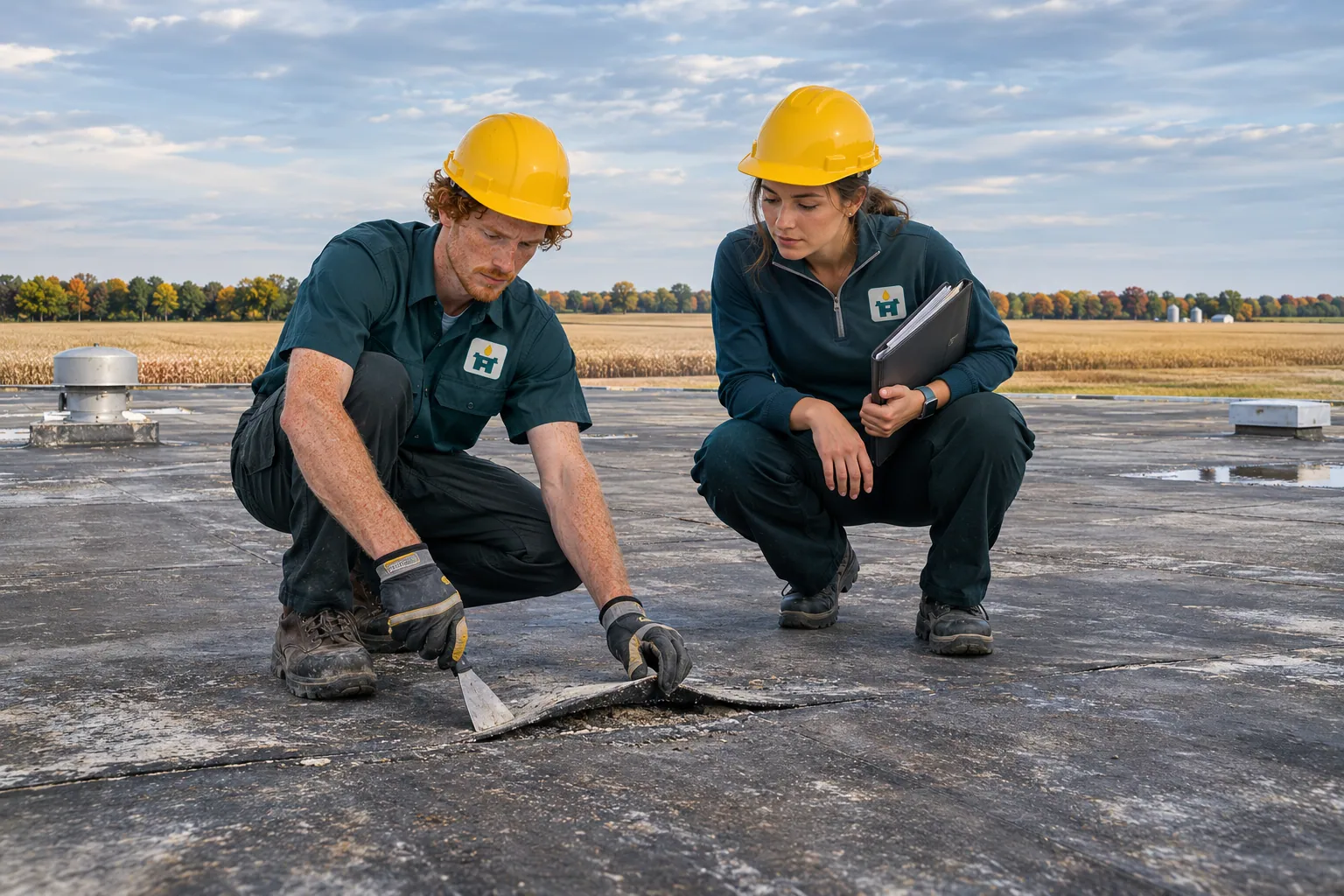
Lifting Seam Laps
Lap edges pull loose where welds have aged or seam tape has dried out. Weathered TPO can resist a new weld, so a cleaning and a test weld come first.

Your Hopkinsville flat roof repair contractor fixes open seams, blisters, punctures, and ponding on TPO, EPDM, PVC, and modified bitumen roofs.
Every Hopkinsville flat roof repair contractor visit starts with this question. Read your roof condition across the three jobs below.
| What The Roof Shows | Patch Or Weld | Section Repair | Bigger Fix First |
|---|---|---|---|
| One or two open seam laps near a curb or drain | Usually Fits | Rarely | Rarely |
| Small punctures beside rooftop units from dropped screws | Usually Fits | Rarely | Rarely |
| A split blister with wet insulation underneath | Sometimes | Usually Fits | Rarely |
| Ponding that leaves a dirt ring days after rain | Sometimes | Usually Fits | Sometimes |
| Clusters of blisters across most of the roof | Rarely | Sometimes | Usually Fits |
A moisture survey settles the last two rows. Clustered blisters often point to moisture inside the roof system.
Most flat roof leaks start where the membrane changes direction or meets another material.
Lap edges pull loose where welds have aged or seam tape has dried out. Weathered TPO can resist a new weld, so a cleaning and a test weld come first.
Trapped air or moisture lifts the membrane into a bubble. Small, firm blisters get watched, while broken or growing ones get cut open and repaired.
Water that stands long after rain wears the seams it sits on. Crushed insulation, a clogged strainer, or a rooftop unit blocking flow are the usual causes.
Dropped screws, tools, and HVAC service traffic poke holes in the membrane beside each unit. A tiny hole lets water into the insulation for months before a stain shows.
Membrane shrinks away from parapet walls and curb corners as it ages. Open corners at those transitions are among the first places checked on a flat roof.
Filler around pipes and supports shrinks and cracks, leaving a ring of open space. Rain runs straight down the pipe into the deck below it.
Each membrane bonds its own way, so the repair method follows the roof material.
| Roof Membrane | Seam Repair | Patch Or Puncture |
|---|---|---|
| TPO | Clean, then hot-air re-weld or weld a cover strip over the lap | Hot-air welded TPO patch past the hole on every side |
| EPDM | Clean, prime, apply seam tape or a cover strip, seal the edge | Primed EPDM patch with pressure-sensitive tape |
| PVC | Membrane cleaner, then a hot-air welded patch | Welded PVC patch; no open flame on the roof |
| Modified bitumen | Heat-weld or cold-adhere a patch over the open lap | Matching cap sheet patch extended past the damage |
Fixing a flat roof at the seam or drain that failed pays off for three groups at the building.
Paint the outline of the pond after the next rain if it is safe to reach. That footprint shows where the low spot or blocked drain sits.
Membrane repairs follow five steps so the patch bonds and the water leaves the roof.
Seams, curbs, wall flashing, and drains are walked and probed. A moisture meter shows whether the insulation under the leak area is wet.
Lap edges and patch areas get washed down to material that will bond. Weathered TPO gets a test weld before the full repair.
Soaked insulation under a blister or puncture comes out and is replaced. Patching over wet board traps the water inside the roof.
Matching membrane goes on with hot air, seam tape, or adhesive, extending well past the damage on every side.
Repaired seams get probed closed, and the next heavy rain shows whether the area drains. A leftover dirt ring marks where more slope is needed.
When a stain inside lines up with no open seam.
Hopkinsville Commercial Roof Leak Repair →A metal shop or warehouse joined to the flat roof.
Hopkinsville Commercial Metal Roof Repair →Plant roofs crowded with fans, pipes, and curbs.
Hopkinsville Industrial Roof Repair →Seams, flashing, and drains cause most of them, since those are the spots where the membrane turns a corner or joins another material. The open field of the roof leaks far less unless something punctures it. A stain inside often shows up some distance from the opening, so tracing starts above the stain and works upslope.
TPO laps are cleaned and re-welded with hot air, or a welded cover strip goes over the lap. EPDM seams are cleaned, primed, and closed with seam tape or a cover strip with sealed edges. Modified bitumen gets a heat-welded or cold-applied patch. Every repaired seam gets probed afterward to confirm it is closed.
Small, firm blisters are watched. Broken or growing ones are cut open in an X or removed, the area is dried, and the insulation underneath is checked. Wet board is replaced, then a matching patch goes on past the cut. When blisters cluster across the roof, a moisture survey comes before any more patching.
Getting the water to a drain fixes it. Clogged drains and scuppers get cleared and new strainers. Low spots from crushed insulation get tapered fill and a membrane patch. Water trapped behind a rooftop unit is split with a cricket, and deck sag between joists goes to a structural review first.
A matching patch goes over the cleaned hole and extends well past it on every side. Insulation under the hole is checked first, and wet board is cut out and replaced. Because punctures cluster near rooftop units, walkway pads go on the service side, loose screws get swept off, and HVAC contractors are asked to report damage.
Tell us whether the water shows at a seam, a drain, or a curb. The membrane gets probed and patched to match.