Cracked Screw Washers
The rubber washer under each screw head hardens and splits with age. Rain then follows the screw shank straight through the panel and into the building.

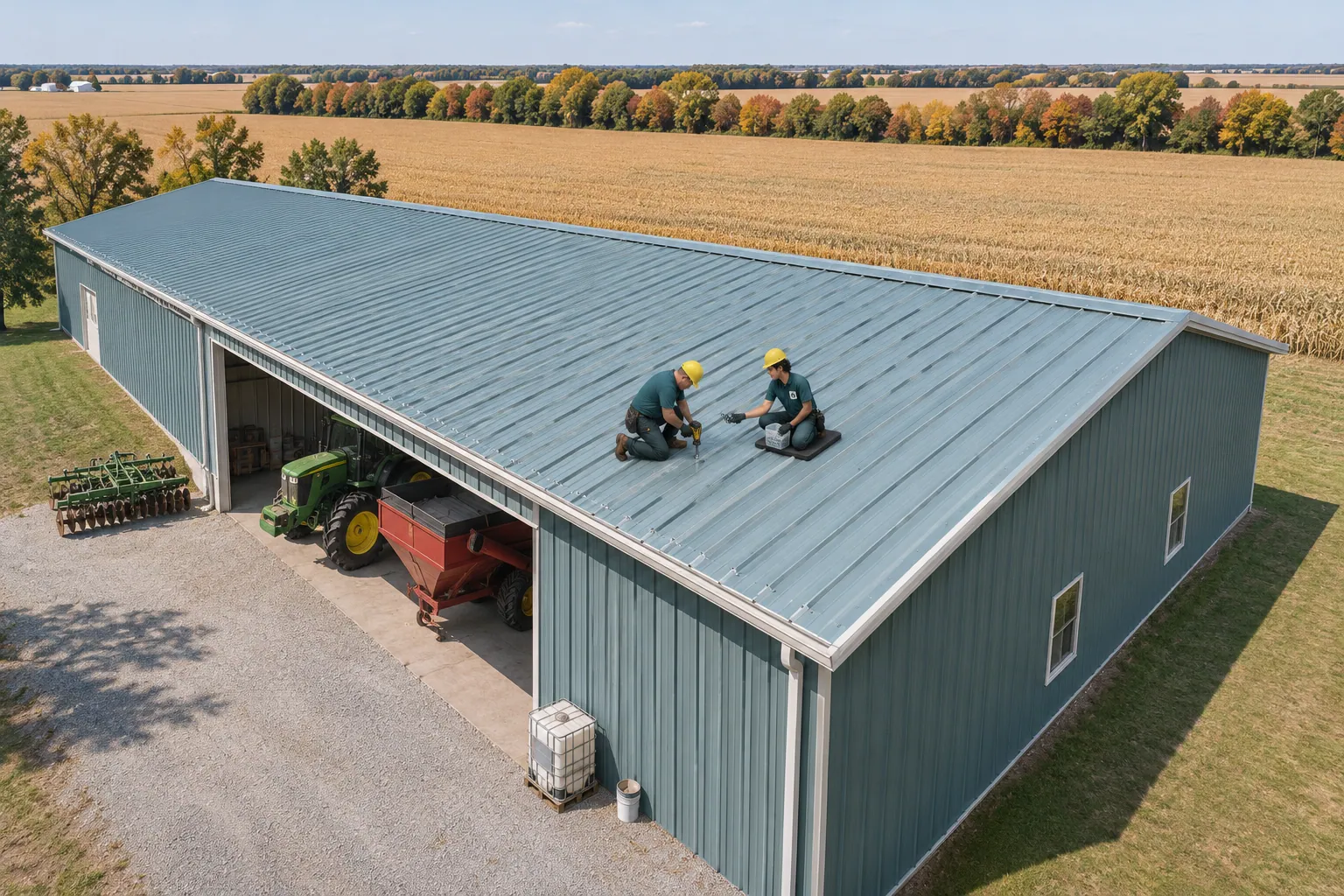
Hire a Hopkinsville commercial metal roof repair contractor to replace failed screws, reseal end laps, and reflash curbs and pipes on metal buildings.
A Hopkinsville commercial metal roof repair contractor sorts metal roofs by what the panels, laps, and purlins show. Read across from your condition.
| What The Roof Shows | Screws And Laps | Panel Swap | Structure First |
|---|---|---|---|
| Drips along a purlin line during rain | Usually Fits | Rarely | Rarely |
| Surface rust and pinholes at a few end laps | Usually Fits | Sometimes | Rarely |
| Rust-through across part of one panel | Rarely | Usually Fits | Rarely |
| Hail cracks in skylight panels | Rarely | Usually Fits | Rarely |
| Rusted purlin under a leaking lap | Rarely | Sometimes | Usually Fits |
Dents alone usually leave the steel watertight. Cracked finish, split laps, and broken skylights are what move a panel into the second column.
Exposed-fastener roofs on shops, warehouses, and farm buildings fail at the same few details.
The rubber washer under each screw head hardens and splits with age. Rain then follows the screw shank straight through the panel and into the building.
Rain sits in the overlap where one panel meets the next. Rust and pinholes form at those laps first, often while the rest of the roof looks fine.
Rubber boots shrink and crack in the sun until the seal around the pipe opens. Sealant smeared over the split leaves the failure in place.
Water piles up on the upslope side of any curb or wall. Joints open there first, and the fix usually adds a diverter above the curb.
An overflowing gutter pushes water back under the panel ends and into the wall. From inside, that looks exactly like a roof leak.
Translucent panels crack where hail strikes, and the cracks spread with each freeze. Broken skylight panels get swapped for ones in a matching profile.
Each repair is matched to the detail that failed and to the panel profile on your roof.
| Problem | What You See | Repair |
|---|---|---|
| Cracked or flattened washer | Drips in a line under the purlins | New screw and washer seated flat and snug |
| Stripped screw hole | A screw that spins without tightening | Upsized screw, or a stitch screw beside it |
| Pinholes at an end lap | Rust stains at panel overlaps | Cleaned lap, butyl tape, metal patch with stitch screws |
| Rust-through across a panel | Daylight or rust holes in one sheet | New panel matching the rib profile |
| Cracked pipe boot | Stain around a vent or flue | New boot formed to the ribs, sealed and screwed |
Replacing failed screws and resealing laps keeps a metal building working for the people who depend on it.
Loose screws on a metal roof get worse as the panels expand and contract each day. Replacing them early keeps the holes from stripping out.
Metal roof repairs move from the low edge up, so water always runs over finished work.
Screw lines, end laps, side laps, ridge caps, and every pipe and curb get checked. Gutters and eave trim are part of the walk.
Screws with cracked washers come out and new ones go in, upsized where holes have stripped. Over-driven screws get swapped so washers seat flat.
Rusted end laps are opened, wire-brushed, primed, and closed with butyl tape and stitch screws. Pinholes get a matching metal patch.
Failed boots and trim come off, the panel underneath is cleaned, and new flashing shaped to the rib profile goes on.
Gutter seams are resealed, hangers added, outlets cleared, and missing closures replaced before the roof is rechecked.
The low-slope office roof attached to a metal shop.
Hopkinsville Flat Roof Repair →When water shows inside far from any screw line.
Hopkinsville Commercial Roof Leak Repair →Metal plant roofs with fans and pipe racks.
Hopkinsville Industrial Roof Repair →Screw leaks start when the rubber washer hardens and cracks, or when the screw backs out as panels move with temperature. Water then rides the shank into the building. The repair covers every screw in the leak area with a new screw and washer, upsizing any hole that has stripped.
The lap is opened, cleaned, wire-brushed, and primed, then closed with butyl tape and stitch screws. Pinholes get a matching metal patch, and rust-through across a panel calls for a new panel in the same rib profile. A rusted purlin under the lap gets a structural repair before new metal goes on.
The failed boot or trim comes off, the panel under it is cleaned, and new flashing formed to the rib profile is sealed and screwed down. Curbs get a cricket or diverter on the upslope side, where water piles up. Headwalls and sidewalls get new flashing with counterflashing or a longer leg.
Gutter seams and end caps are resealed, hangers are added where the gutter sags, and downspout outlets are cleared or resized. At the eave, missing foam closures under the panel ribs are replaced and the trim is refastened with new screws. An overflowing gutter can push water under panel ends and into the wall.
Usually, yes. Cosmetic dents are documented and the panel stays. Cracked paint at dents gets primed and repainted, or badly hit panels are swapped. Broken skylight panels get new ones in a matching profile, and loose screws in the impact area are replaced. Take dated photos before repairs and share them with the insurance carrier.
Point us to the drip line, the rusted lap, or the boot that leaks. Screws, laps, and flashing get fixed to match your panels.