Ceiling Tile Stains
A brown ring on a tile marks where water finally dripped through. The roof opening usually sits upslope of it, sometimes several feet away.

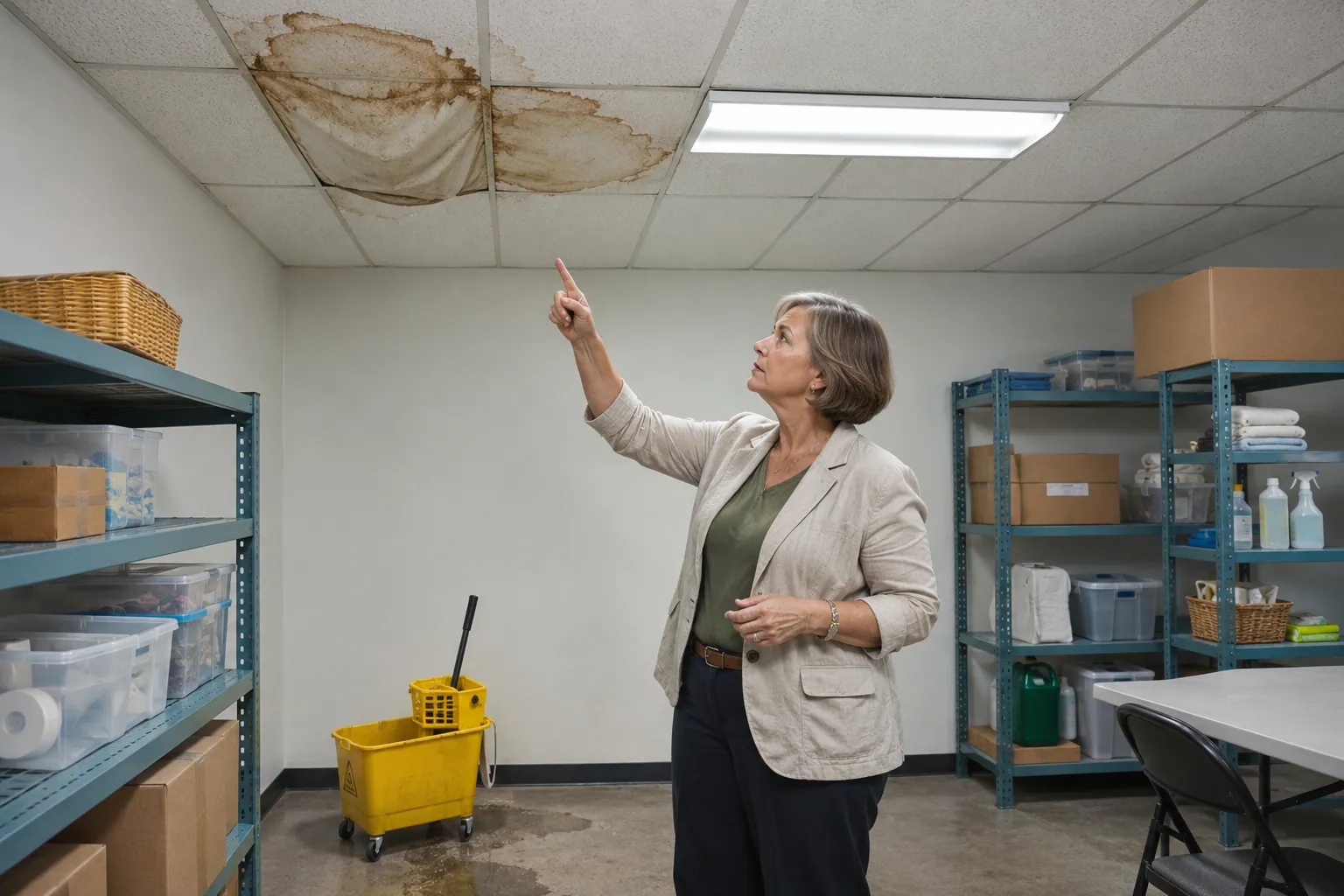
Call a Hopkinsville commercial roof leak repair contractor when a stain or drip appears inside. Each leak is traced on the roof before it is repaired.
A Hopkinsville commercial roof leak repair contractor sorts each leak by how clearly it points to its source. Read across from what you see inside.
| What The Roof Shows | Fixed On The Visit | Temporary Then Return | Other Trade First |
|---|---|---|---|
| Stain under an open seam or cracked boot | Usually Fits | Rarely | Rarely |
| Drip that starts only in wind-driven rain | Sometimes | Sometimes | Rarely |
| Active leak during a storm or a freeze | Rarely | Usually Fits | Rarely |
| Water around a rooftop unit on dry days | Rarely | Rarely | Usually Fits |
| Wall-base stains after flooding | Rarely | Rarely | Usually Fits |
Condensate lines and cabinet panels go to the mechanical contractor, and wall-base water after a flood points to drainage or plumbing.
Water often travels along deck flutes or insulation joints before it drips, so these signs start the trace.
A brown ring on a tile marks where water finally dripped through. The roof opening usually sits upslope of it, sometimes several feet away.
Straight-down rain runs past coping joints, through-wall scuppers, and ridge closures. Wind pushes water sideways into those same details.
Many leaks blamed on the roof come from a clogged condensate line or a loose cabinet panel on the unit itself.
Water around a rooftop unit when it has not rained points to the unit, while a duct seam inside the curb shows up during cooling season.
Moisture readings around a stain show how far water has spread under the membrane. Wet board gets cut out during the repair.
Freeze and thaw open small gaps in seams and sealant, and ice at drains backs water up under laps. Permanent repairs wait for a dry, warmer day.
Some leaks get a stopgap first. Each temporary patch is logged until the permanent repair replaces it.
| Factor | Temporary Repair | Permanent Repair |
|---|---|---|
| Materials | Roof cement, mastic, repair tape | Matching membrane, weld or tape, new metal |
| Surface prep | Minimal, often on a wet roof | Cleaned, dry, primed |
| When used | Active leaks, storms, freezing days | Dry weather with proper prep |
| Follow-up | Needs a return visit | Checked at routine roof walks |
A leak traced to its real opening gets fixed once, which matters to everyone under that roof.
Note the wind direction and how long it rained before the drip started. Those notes point the trace toward walls, scuppers, or laps on that side.
Leak tracing follows the water backward, from the drip inside to the gap on the roof.
Interior and roof measurements match the stain to the roof above it. The search then works upslope and outward to each seam, curb, and penetration.
Seams, flashing, and pitch pans get a close visual check, and welded membrane gets probed. Rooftop units near the stain are opened and checked too.
Readings around the suspected area show how far water has traveled under the membrane and which insulation needs to come out.
Water is run at one detail at a time, sideways where wind is the cause, until the drip inside starts again.
The opening is marked, photographed, and repaired, then checked again after the next rain falls on the roof.
Traces that end at a membrane seam or drain.
Hopkinsville Flat Roof Repair →Screw lines and end laps found during the trace.
Hopkinsville Commercial Metal Roof Repair →Fans, pipe supports, or joints the trace points to.
Hopkinsville Industrial Roof Repair →Tracing starts at the stain inside, which is measured and matched to the roof above. From there the search works upslope and outward through every seam, curb, and penetration, with a seam probe on welded membrane, moisture readings, and a controlled water test on one detail at a time. The leak is then marked, photographed, and repaired.
TPO and PVC leak at seam welds, curb corners, and pipe boots. EPDM leaks at seam tape edges, T-joints, and shrinking wall flashing. Modified bitumen and built-up roofs show blisters, cracked flashing, and dried pitch pans. Standing seam metal fails at end laps and ridge closures, and R-panel roofs at screw washers, side laps, and gutters.
A temporary repair uses roof cement, mastic, or tape to stop water for now, often on a wet roof during a storm or cold snap. A permanent repair restores the roof material with a matching patch, new flashing, or new metal on a clean, dry surface. Every temporary patch is logged so it gets replaced.
Wind pushes water sideways or uphill into vertical and edge details that straight rain runs past. Check parapet coping joints and counterflashing, through-wall scuppers, end laps and ridge closures on metal roofs, loose access panels on rooftop units, and wall vents above the roof line. A sideways water test at each spot isolates the source.
Water around the unit on dry days points to a clogged condensate line. Rain getting in through loose cabinet screws or gaskets, or a stain under the curb only in cooling season, also points to the unit. Open corners in the curb flashing and cracked pitch pan filler are roof repairs. Unit problems go to the mechanical contractor.
Send the photo of the stain and when it started. The trace begins on the roof right above it.